Wednesday, 1 July 2009

FILM REVIEW - La Regle de Jeu...

...

Jean Renoir's La Regle de Jeu ranks among my favourite classics, alongside Citizen Kane, Rio Bravo, and Renoir's war film La Grande Illusion. Like Citizen Kane, it's a critics' favourite that really is super-entertaining. I can't think of a single flaw with this film. The narrative flows beautifully, the performances are all fantastic and real, and Jean Renoir's direction balances comedy and tragedy, complexity and simplicity, chaos and order beautifully and effortlessly...
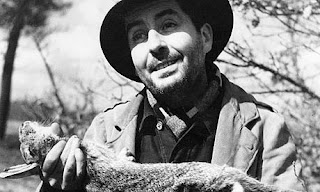
Very different in terms of story and character to La Grande Illusion but thematically quite similar, it's about the tragic contradictions and irrationality of human behaviour and the collapse and folly of the bourgeosie lifestyle. The story concerns a number of characters who meet up at a rich man's chateaux in the French countryside. It opens with the arrival of a hot shot pilot who has just crossed the Atlantic in record time. The press swamp him and congratulate him but he has a look of longing and disappointment on his face for the woman he loves has not arrived to greet him. She is "Madame," the wife of the rich man, very much the opposite of the pilot; gaudy and showy. The character central to the events and clashes of the film is Octave, played comically by Jean Renoir himself. He is loved by all and so his life is empty, he rushes between characters, helping everyone but ultimately failing to uphold any order. He is sad yet strong, a large, gruff bear with good intentions. He orchestrates a meeting between Madame and the pilot so that the pilot can reclaim her from the rich man. And from here we follow a host of other characters around the vast, seemingly infinite corridors of the chateaux, including a feisty but faithfuly female servant, an equally feisty poacher-turned-servant played by an actor from La Grande Illusion, can't remember his name, who has a fling with her, the ex-lover of the rich man, and various other characters. They are filmed with an almost constantly mobile camera, tracking them and making them seem like kids in a play-room, endearing yet pitiful, and somewhat mad. Another actor from La Grande Illusion, who also played the persecuted man who infiltrated bourgeois society in Bunuel's thematically similar L'Age D'Or, plays a fiery hunter and guard of the chateaux, who when faced with the prospect of his wife, the feisty servant, being stolen by the poacher, goes mad with anger, leading to his being thrown out of the chateaux and his emotional breakdown. There is conflict and confrontation in literally every frame of this film; it's a very noisy and busy film. People fight and take sides, double-cross each other, much like in a children's game, but have rules of etiquette they follow, as do children in a schoolyard. The people in this film are very real, and Renoir the brilliant writer holds deep empathy for every one of them, snapping between different points of view and filming each character internally. They chat and make small-talk, and put on facades, as is the tradition of their lifestyle, but so often find themselves lost, staring at their feet. They are broken, and disgraceful, and funny, jumbling around in a kind-of bourgeois apocalypse, with shows and ghostly ceremonies symbolising the death and emptiness of this lifestyle. But through the sacrifice of the pilot at the hands of the unknowing guard who thinks he's Octave who's running off with his wife, order is restored, and the bourgeious retreat back into their comforts, hiding from the oncoming conflict known as the Second World War. So the bourgeious values of pleasure and politeness result in the temporary downfall of a country at the hands of the Nazis. Indeed this film was banned by the Nazis, who saw it as "demoralising," as with La Grande Illusion. Both films are about humanity and the tragic contradictions and orders and barriers that plague it. In La Regle de Jeu there is a tour-de-force sequence, in which rabbits and chased out of woodland by men, only run into the line of fire of Madame and her guests. Madame deliberately misses. She is the object of desire for the pilot and her husband, and at one point of her best friend Octave. In the end one of the men is chased towards her by his desires and finds himself in the line of fire of the emotionally shattered guard. The slaughter of the rabbits is something of a precursor to this, a kind-of genocide. The rabbits run in the open and it is sheer luck that any of them survive. The characters in this film are rabbits, blinded by desire and fear, and shot down by life, victims of the bourgeious lifestyle...

The film has no heroes or villians, Renoir didn't think that way. Rather than attacking people, it attacks the circumstances of their lives; the bourgeious institution. It is a warning against the glutton and idleness of this lifestyle. It is passionate and energetic, and one of the best films ever made; dark yet light, walking a tightrope between madness and meaning; an absolute dream of a film.
As Octave would say, "there is one thing that is terrible, and that is everyone has his reasons." That is the tragic meaning at the heart of this film...
Sunday, 28 June 2009

No posts for a LONG time...

...but at the moment I'm trying to get an interview with filmmaker Paul Bortowski up.

Thursday, 4 June 2009

Apocalypse Now VS Apocalypse Now Redux...


VS


I'm going to have to go with the Redux. Why? It's far more lucid, expansive, shocking, funny, detailed and insightful. The original in comparison feels like a rushed job, but who could blame Coppola for wanting to end the film that had almost cost him his mental well-being and his family life? The original is spectacular but very flawed, and it feels like Coppola was simply using a Vietnam backdrop to abstractly explore the human mind, instead of really portraying the war in any great detail. Some argue that that the former approach was better, that it gave the film a more personal and surreal feel, but I think it's quite narrow, simply following Willard's path further and further into darkness and then having him triumph and leave into an unseen light. In the original we are given no insight into the secondary characters. They are just along for the ride and don't have much attention paid to them. As compelling as Willard is, I was longing to learn more about the others. They were merely seen having banter with each other and reacting to things. Of course you could argue that it's only appropriate, as it's Willard's story and is told from his viewpoint. But again I think that's narrow. Now to be fair, the Redux doesn't improve on this greatly. We are given a lot more time with them but they are still often just reacting to things and squabbling and having banter. But these scenes do in fact give more insight into Willard and the way he is socially, as they show him interacting and growing to like and care for his companions. It makes his character more touching and human.

Now while I really like the original, one of the problems I had with it, that perhaps came from me, I'm not certain, was that it was so much fun. Was it supposed to be showing the attraction to war and destruction? Perhaps. And it did balance that out a little with truly shocking moments of moral horror. But at the same time I felt that the film was more attracted to the evil of the bombastic and lunatic Col. Kilgore than repelled by it. And I also felt that perhaps it was attracted to the chaos. It's such a contradictory film, and I'm not sure some of the ambiguities that form are deliberate. It portrays horror and death and chaos and insanity with a kind of savage and luminous beauty and grace, lending the film real artistic perversity. So in short, I didn't know what to think of the film. Now many, myself included, consider this a good thing, that the film is what you make of it. I usually consider this a good thing, but I felt that weakens the film and gives it a half-hearted feel thematically. The Redux however casts aside any ideas that Coppola was attracted to the war and the chaos, as there are some truly shocking, disturbing and grim moments that the original sorely missed. For instance, in one brilliant scene, they come across a medical encampment where the Playboy bunnies seen earlier at the USO show are staying, and Lance and Chef, horny as hell having been out-of-contact with the female for a long time, decide to spend some quality time with them. While the bunnies talk about their personal lives the men grope them and treat them like dolls, putting fantasy wigs on them and putting them in poses. The scene is blackly humorous in parts, with one of the bunnies talking openly about how she feels lonely and can't truly communicate with men, while Lance, oblivious to what she's saying, gropes and feels her, glowering over her body. The scene reaches a truly disturbing climax as the bunny tells of how she was once made to do something against her will, as Lance corners her. Then a trunk falls over revealing a dead body inside, and she breaks down. Lance takes advantage of the emotional weakness this horror is causing and proceeds to have sex with her. As with the helicopter attack sequence the scene alternates nimbly between black comedy and horror. Indeed the Redux is much funnier than the original, and Willard is actually given a light touch, shown laughing and getting into shenanigans with the others. The mess and chaos of the Vietnam war is just given more of a shockingly absurdist edge.

And finally, the order of the footage in the Redux seems to make more sense than that of the original. Some have argued that the new narrative order of the Redux detracts from the flow of the story, and goes off in too many tangents. But really there's just a lot more happening. The original went for narrative simplicity, with Willard descending deeper and deeper into hell down the river, but let's be honest, this isn't hugely interesting. Some argue that it has a dreamlike quality. Maybe it does, but what good is that? The narrative of the redux and the addition of whole new scenes, like the French Plantation scene, gives it more authenicity and says much more about the Vietnam war. The original film naively avoids any real political ambiguity, instead opting to portray those in charge of the war as lying hypocrites and gung-ho loonies and those under their command as hedonistic, susceptible, foolish teenagers. So the original feels narrowly, adolescently and nihilistically anarchistic in parts. But in the Redux, the French Plantation scene offers a political angle on the story, as they come into contact with a long-standing colony of French people living by the river near the border to Cambodia. And so there ensues a dinner sequence in which the French men argue with Willard over their right to live in Vietnam and over the futility of the war. The differences between the American way of thinking and that of the French are made clear, but are overcome when Willard has a brief love affair with an elegant French woman.

The final scenes at the Kurtz compound are greatly improved. Brando is given more screen time, and more of his character is revealed. Many say that this ruins the mystery of his character and the aura of insanity and evil he gives off, but this is a really adolescent argument to make. Why should certain interesting aspects of Kurtz be left out for the sake of putting on a show? Earlier, the French woman says there are two sides to a soldier, one that loves, and one that kills. Kurtz is capable of the worst atrocities, beheading hundreds and ordering hangings, yet he is shown playing with children. Instead of rambling all the time as in the original, he is seen speaking with a clarity and calm, suggesting some sort of alternate sanity. So these scenes actually add to the mystery of Kurtz. The finale is the same as that of the original, ambiguous, meaningful and unsettling. And the ending to the original needed no improvement or change, only the narrative before it. And so with the newly arranged narrative and extra footage, the Redux is by far the superior film, much fuller, more disturbing, and far more convincing...